Pose Maxing: Fix the Pose in a Photo You Already Have
Most photos fail on the pose, not the face: weight on both feet, square to the lens, hands with nothing to do. Pose Maxing corrects exactly that in a photo you already have, and leaves everything else alone — the place, the people, your clothes and your face. Pose Maxing is also searched as posemaxing or posemaxxing — same tool, same page.
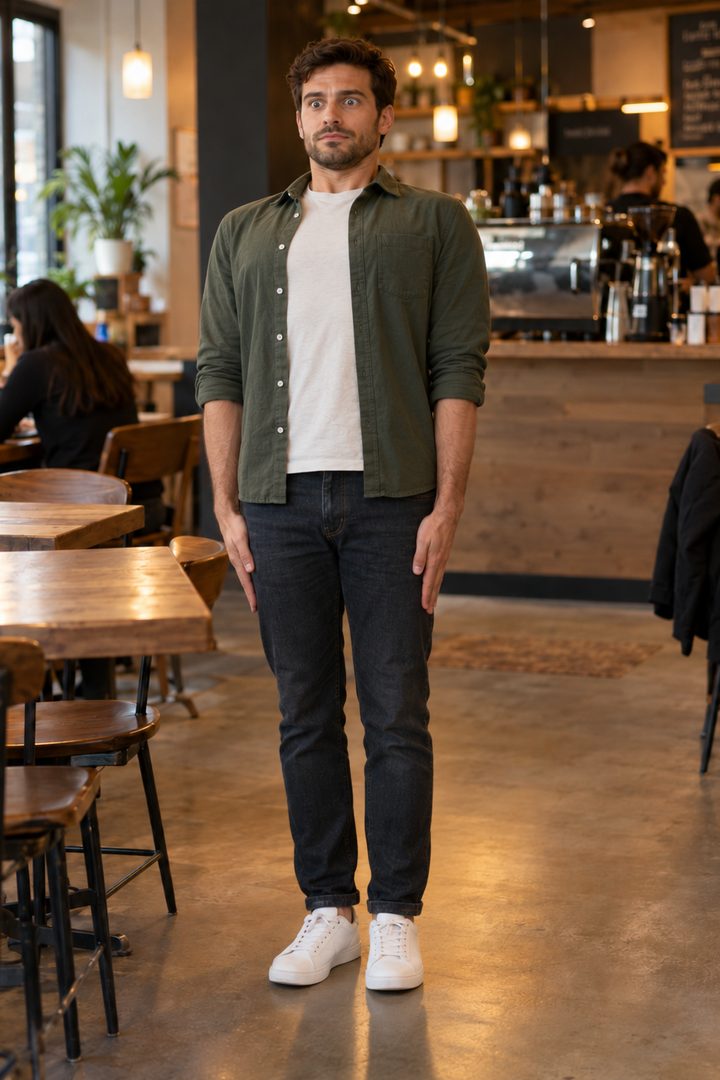
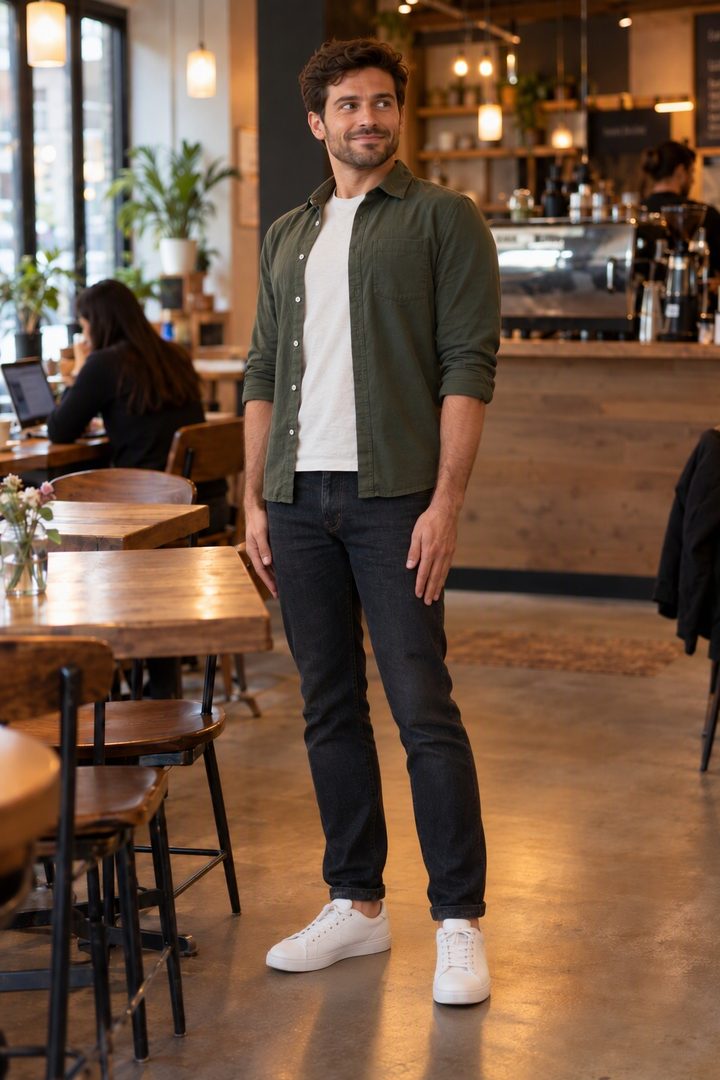
What pose maxing actually changes
It re-poses the person already in your photograph. Your face, your clothes, the room and the light stay as they were; what moves is the body: the angle of the shoulders, where the weight sits, what the hands are doing, where the eyes go. Nothing is beautified, nothing is slimmed, and no feature is replaced. If the result stops looking like you, it has failed, and there is a thumbs down under every photo for exactly that.
Why the pose decides more of the photo than the face
Most advice about dating photos is about the shot: the light, the angle, the smile. In practice the first thing anyone reads is posture, because it is the part of a photograph that says what kind of person is in it before any detail is examined. Square shoulders facing the lens, arms pinned to the sides and a chin pushed forward read as a passport photo, whoever is in it. The same person turned forty degrees, weight on one leg, one hand occupied, reads as somebody who was photographed in the middle of their life.
This is also the part you cannot see in your own photos. You know what your face is doing. You have no idea what your shoulders are doing, because you have never watched yourself from the outside.
The poses that work, and what each one is for
Standing, turned. The body at an angle to the camera with the face coming back to it. It narrows the silhouette honestly, by geometry rather than by editing, and it stops the photo reading as an official document.
Seated. A chair, a step, a low wall. Sitting solves the hands problem on its own, gives the frame a diagonal, and tends to relax the shoulders, which is where tension shows first.
Hands with a job. A cup, a pocket, a strap, a sleeve. Hands with nothing to do hang like an afterthought, and everyone can tell. One hand occupied is usually the difference between a photo that looks taken and a photo that looks posed.
Gaze away. Not every photo needs eye contact. One frame looking off is what makes a set look like a day rather than a session, and it is the shot people most often do not have.
Breaking the symmetry. One shoulder lower, one knee bent, the head tilted a few degrees. Perfect symmetry is the single most common reason a photograph looks stiff, and it is also the easiest thing to fix.
What makes a pose fail
Arms crossed high on the chest, which closes the whole frame. A chin pushed towards the lens, which every phone exaggerates. Both feet flat and square, which plants a person like furniture. The mirror selfie, where the phone is the subject and you are behind it. And the group photo cropped down to one person, which keeps somebody else's shoulder in your profile picture.
Men and women, and what genuinely differs
Less than the internet suggests. The same five ideas apply to everyone: turn, break the symmetry, occupy the hands, relax the shoulders, vary the gaze. The library is split by gender only so the suggestions stop recommending the handful of poses that read oddly on one or the other, and the choice is yours rather than something guessed from your photograph.
What it cannot fix
A blurred photograph stays blurred. A face in heavy shadow or behind sunglasses gives the model nothing to work with. A photo cropped so tightly that there is no body in it has no pose to change. And it will not make you look like somebody else, which is the entire point: a photo that wins attention and then meets a different person in a cafe has cost you the evening.
What happens to your photo
The photo is sent to Azure OpenAI and OpenAI to make the edit, and it is not used to train any model. Without an account, your photo and the result are deleted after 24 hours. With an account, the result goes to your gallery and stays until you delete it. One free fix a day either way.
Common questions
Will it still look like me?
That is the thing it is measured on. The face is kept from your own photograph rather than rebuilt, and the clothes and background are untouched. When the likeness slips, mark the result with the thumbs down: those are the reports we work from.
How many fixes can I combine at once?
A few, and fewer is usually better. Asking for a turned body, new hands, a different gaze and new lighting in one go is asking for a different photograph, and the further it travels from the original the less it looks like you.
Can I use a photo somebody else took?
Use photos of yourself that you are entitled to use. The tool edits a person in a photograph, so the person in it should be you.
Is it free?
One fix a day free, no account needed, while the free promotion is running. After that a fix costs the same as any other photo on CMeIn, and an account gets you a closer likeness because the photos in your gallery go in as references.