Why AI Photos Don't Look Like You (And What Actually Fixes It)
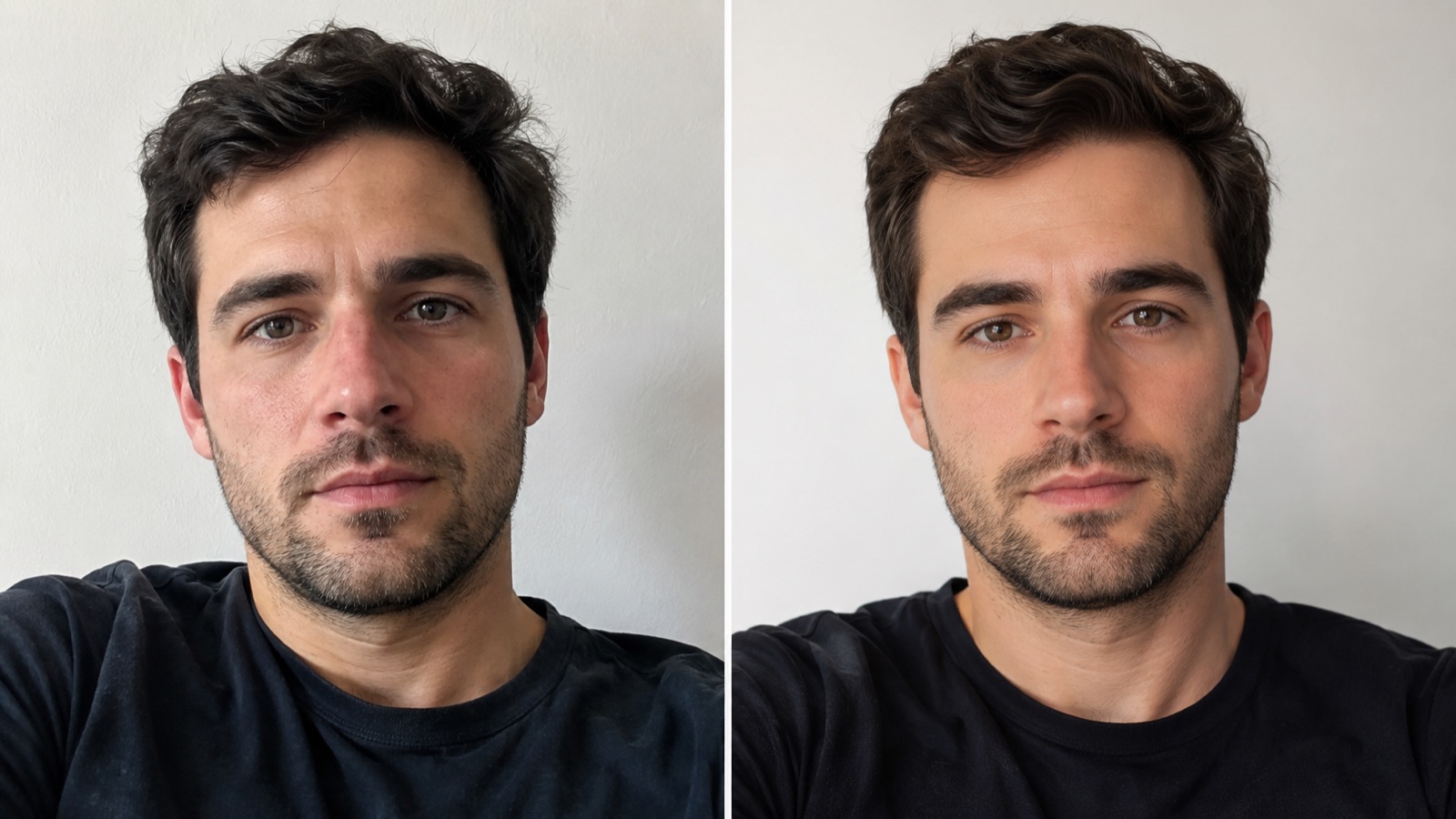
You uploaded your photos, you waited, and what came back is a stranger with your haircut. Maybe a cousin. Younger, smoother, symmetrical in a way you have never been — technically a great photo of a person who isn't you.
You're not imagining it, it isn't your face's fault, and it isn't random. There are four causes, and three of them are things you can control before you generate anything.
1. Your uploads gave it one angle to work from
Every one of these systems builds an internal approximation of your face from the photos you hand it. That approximation is only as complete as what you gave it.
Most people upload their best photos — which means eight versions of the same three-quarter selfie, same phone, same arm, same half-smile, same room light. From the system's point of view that's one data point repeated eight times. It has no idea what you look like straight on, laughing, in daylight, or from slightly below. So when the scene calls for those, it invents them — and its inventions come from the average face, not from yours.
This is the single biggest cause, and it's entirely in your hands. Coverage beats quality: different days, different angles (including straight-on), different expressions (including a real laugh, not a posed one), ordinary light from different directions.
2. The model drifts toward "attractive," and attractive isn't you
Image models are trained on data filtered for aesthetic appeal, so their default direction of travel is prettier. Skin gets smoothed, the jaw gets tidied, asymmetries get corrected, a few years quietly disappear.
Every one of those edits reads as an improvement to the model — and as the wrong person to anyone who knows you. Faces are recognized by exactly the things being cleaned up: the slightly uneven eyebrow, the line by the mouth, the nose that isn't centered. Polish removes the fingerprint.
This is also why the fix people reach for makes it worse. Adding flawless, beautify, perfect skin, model to a prompt doesn't improve the photo; it accelerates the drift away from your face.
3. Dramatic lighting hides what your face is recognized by
A face is identified by a small set of landmarks — the shadow under the nose, the depth of the eye sockets, the edge of the jaw, the shape of the upper lip. Ordinary, flat-ish light shows all of them. Moody side-lighting, warm overhead light and heavy contrast bury half of them in shadow.
The photo looks better. It also looks less like you, because the system had to fill in the buried half. Any generation prompt that leans on drama is trading identity for atmosphere.
4. Turned heads are where likeness breaks
The further your head turns from the camera, the less of your actual face is in frame — and the more the model is reconstructing rather than reproducing. Profile shots, over-the-shoulder glances and anything looking away are where the drift is worst and the "that's not me" reaction is strongest.
A good set can include one turned-head photo. If your whole set is turned heads, you're asking the system to invent your face four times.
What actually fixes it
Upload for coverage, not for flattery.
- 8–15 ordinary photos, different days
- Straight-on, three-quarter, and one from slightly below
- At least one real laugh and one neutral face
- Daylight, indoor light, evening — variety of ordinary light
- No sunglasses, no hats pulled low, no heavy filters, no group shots where your face is 40 pixels wide, no photos with a partner cropped out badly
Then judge the output on one test only. Not "is this a good photo." Instead: would someone who knows your face scroll past it without pausing? That's the same test the person across the table will run on the first date — and it's the only one that matters, because a beautiful photo of a stranger costs you the match twice: once when she doubts it, and again when you arrive.
Why "professional AI headshots" are worse at this
It looks backwards, but it's consistent: polish and beautification are the same operation, and that operation is what erases you. A studio-style headshot pipeline is optimized to make you look impressive — smoother, sharper, better lit than life. Every one of those steps removes identity information.
Candid, ordinary-light photos hold onto far more of your face, because nothing is being cleaned away. That's also why they work better on dating apps, where being recognisable is the entire job — and where "impressive" is what makes people suspicious in the first place.
The short version
The tool didn't fail because AI can't do faces. It failed because it was given one angle, told to make you beautiful, and lit you like a perfume ad.
That's the problem CMeIn is built around: the system reads which angles and expressions your uploads actually cover, picks the reference combination that fills the gaps, and generates ordinary-looking moments with your face held steady — candid, unpolished, and unmistakably you. Credit packs from $2.99, no subscription.
Run it against the only benchmark worth using: show the result to someone who knows your face, and watch whether they pause.